陈兵教授研究团队揭示全球能源消费导致的人为热释放加剧全球高温热浪和人口暴露、森林火灾的风险
云南大学地球科学学院云南省高校低纬高原大气环境与边界层过程重点实验室陈兵教授研究团队在人为热释放影响全球极端气候研究领域取得系列重要进展。团队近期连续在AGU旗下国际知名期刊《Journal of Geophysical Research: Atmospheres》(Nature Index期刊)上发表题为“Energy-driven anthropogenic heat exacerbates spring heatwaves and human exposure risks in South Asia by 2100”和“Energy-consumption-induced Anthropogenic heat release intensifies heatwaves and wildfire threats in North America: A CESM2-based projection for the late 21st century” 2篇论文,系统揭示了人类能源消费产生的人为热释放对全球不同区域未来极端热浪的影响和及加剧了对人体健康、森林火灾的风险。两篇论文的第一作者均为我校硕士研究生王瑞琳,陈兵教授为通讯作者,云南大学为第一完成单位。
人为热释放(Anthropogenic Heat Release, AHR)是指人类在能源消费过程中直接排放到地球-大气系统中的热量。这类热量来源于人类活动消耗能源所产生的废热,在全球范围内呈现高度不均匀的空间分布特征,尤其是在主要城市化区域形成显著的热源。作为直接影响区域能量平衡的重要因素,人为热释放已成为一个不可忽视的人为强迫因子。为系统评估其对21世纪末期气候的潜在影响,研究团队基于IPCC SSP5-8.5排放情景,利用美国NCAR开发的CESM2模式,开展了精细化的数值模拟试验。通过对比包含与不包含人为热释放强迫的试验结果,定量揭示了21世纪末人为热释放对南亚春季和北美夏季气候的影响及其气候反馈的物理机制。
研究表明,人为热释放通过影响能量平衡和大气环流过程,加剧了南亚和北美地区的极端高温风险。在能量平衡层面,人为热释放加热边界层大气,降低对流层低层稳定度,减少低云量,从而增加地表吸收的净短波辐射;同时促使地表和低层大气发射更多向下的长波辐射,共同改变地表能量平衡,导致显著增温。在大气环流层面,人为热释放改变了大尺度环流格局,在南亚西部和北美西部均增强了反气旋式环流及下沉运动,抑制了对流发展和降水形成,同时减少了关键的水汽输送(如印度洋至南亚西部的水汽输送),使得区域气候呈现“更热、更干”的变化趋势。上述变化将直接加剧21世纪末期的极端热浪事件。模拟结果显示,在人为热释放的影响下,南亚春季平均气温预计上升约0.57°C;北美夏季平均气温预计上升约0.60°C。热浪风险的加剧将进一步引发严峻的社会与生态后果。在南亚,人口暴露于白天和夜间热浪的风险预计将分别增加约9%和13.9%。在北美,人为热释放将增加大部分地区夏季的饱和水汽压差,从而增加未来野火发生的潜在风险。
这两项系列研究共同揭示,由能源消费直接产生的人为热释放,不仅是城市热岛效应的驱动因子,更能通过改变区域能量平衡和大气环流,在宏观尺度上独立地加剧21世纪末极端热浪及其连带灾害风险。研究成果表明,在未来的气候变化风险评估及适应策略制定过程中,需要更加系统地考量人为热释放的气候效应。这一发现为深入理解人类活动对气候系统的多重影响提供了新的科学视角,同时也为全球高风险区域应对未来气候挑战提供了重要的科学依据。
文章信息:
Wang, R., Wu, X., Chen, B., Lin, G., Wu, C., Luo, T., et al. (2025). Energy-Consumption-Induced Anthropogenic Heat Release Intensifies Heatwaves and Wildfire Threats in North America: A CESM2-Based Projection for the Late 21st Century. Journal of Geophysical Research: Atmospheres, 130(23), e2025JD044290. https://doi.org/10.1029/2025JD044290
Wang, R., Zhang, M., Chen, B., Lin, G., Yang, H., Wu, C., et al. (2025). Energy-Driven Anthropogenic Heat Exacerbates Spring Heatwaves and Human Exposure Risks in South Asia by 2100. Journal of Geophysical Research: Atmospheres, 130(13), e2025JD043632. https://doi.org/10.1029/2025JD043632
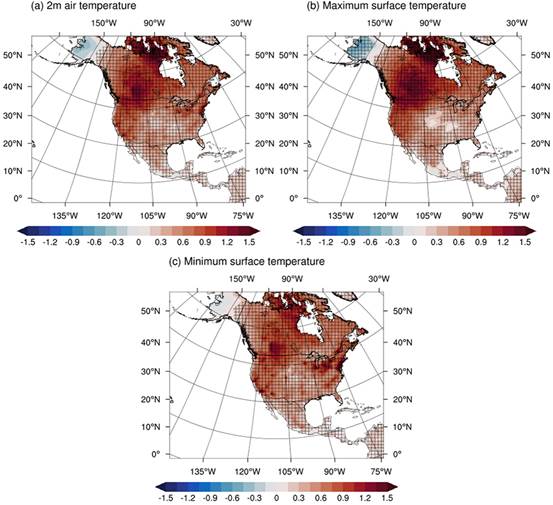
Figure 1. Impacts of Anthropogenic heat release on summer (JJA) surface temperature in North America from 2081 to 2100 (unit: °C): (a) mean temperature; (b) maximum temperature; (c) minimum temperature. The shaded areas indicate statistically significant changes at the 0.05 level.
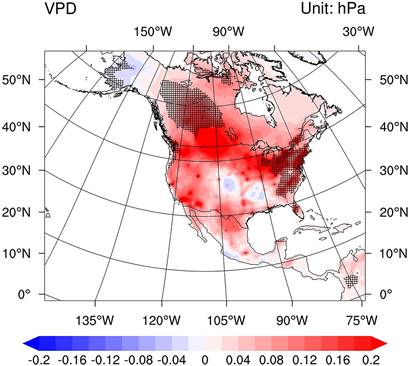
Figure 2. Impact of Anthropogenic heat release on the vapor pressure deficit during summer from 2081 to 2100 (unit: hPa). The shaded areas indicate statistically significant changes at the 0.05 level.
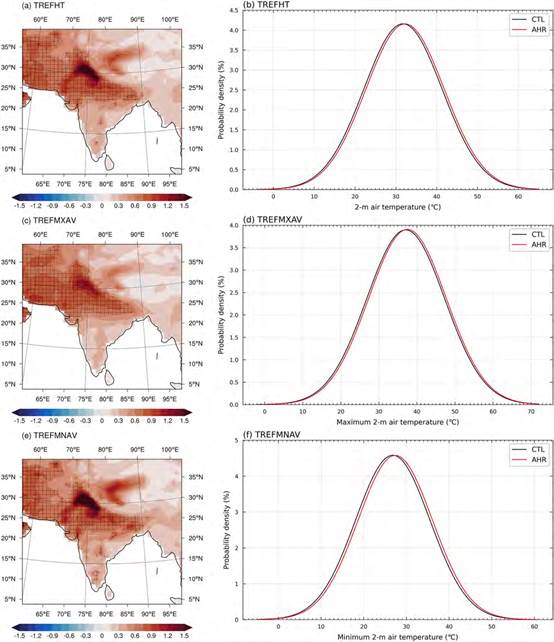
Figure 3. Impacts of Anthropogenic heat release (AHR) on surface temperature in South Asia during spring (MAM) at the end of the 21st century (units: K), showing (a) mean temperature, (b) probability density distribution of mean temperature in statistically significant regions considering AHR (red) versus control experiment (black), (c) maximum temperature, (d) probability density distribution of maximum temperature in statistically significant regions considering AHR (red) and control experiment (black), (e) minimum temperature, and (f) probability density distribution of minimum temperature in statistically significant regions considering AHR (red) versus control experiment (black). Shaded areas indicate changes that are statistically significant (p < 0.05) based on t‐test.
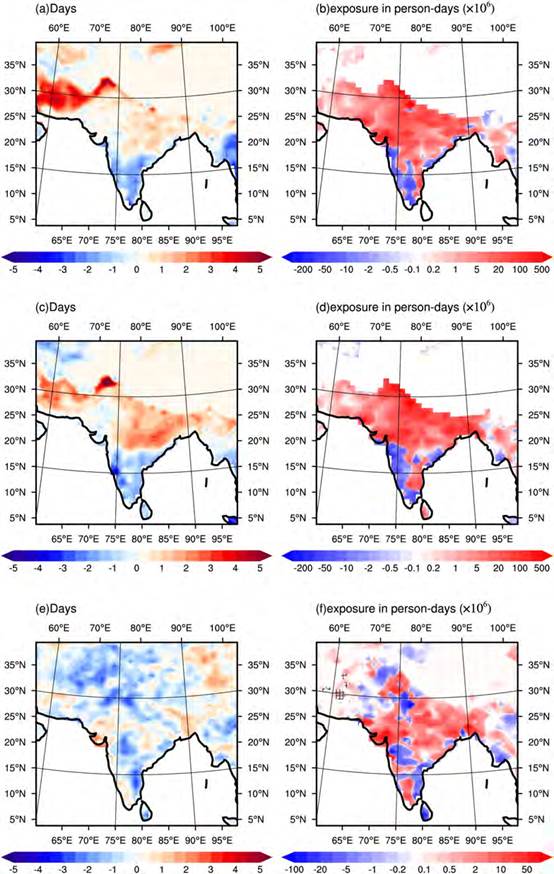
Figure 4. Impacts of Anthropogenic heat release on annual heatwave days and population exposure (units: person‐days) during springtime (MAM) in South Asia at the end of the century: (a) Daytime heatwave days, (c) nighttime heatwave days, (e) compound daytime‐nighttime heatwave days, (b) population exposure to daytime heatwaves, (d) population exposure to nighttime heatwaves, (f) population exposure to compound daytime‐nighttime heatwaves. Shaded areas indicate changes that are statistically significant (p < 0.05) based on t‐test.